Asuna Watase
5 Centimeters per SecondAsuna Watase’s story begins with a child who wants friendship but does not know how to approach it, and carries her from a familiar lookout on Mount Obuchi into Agartha and back again. The overlook gives her somewhere to be alone without worrying about other people; after her journey, its return to view—and a possible flash of blue light there—makes that familiar place resonate with what she has experienced beyond her ordinary world.
Identity and Early Disposition
Asuna is in sixth grade when the book shows her receiving the results of her term finals. The classroom scene is framed, in her thoughts, as a public execution: the students’ scores are being read aloud as their answer sheets are returned. To distract herself from the ordeal, she imagines her reflection as a ghost with large eyes, a trim nose, petite lips, and a pixie cut. The fanciful self-description offers a small, comic counterpoint to the anxiety of having her performance exposed before the class. It is Asuna’s private attempt to redirect her attention, not evidence that she sees an actual apparition.
The glimpse of her daydreaming self also sits beside a more consequential fact about her childhood: Asuna wants friends, as other children do, but does not know how she is supposed to interact with them. Her solitude is therefore not presented as a lack of desire for company. It is a place she can manage because social contact feels difficult to navigate. That tension—longing for connection while finding refuge in being alone—gives the Mount Obuchi lookout its emotional importance.
The Lookout and Her Solitary Routine
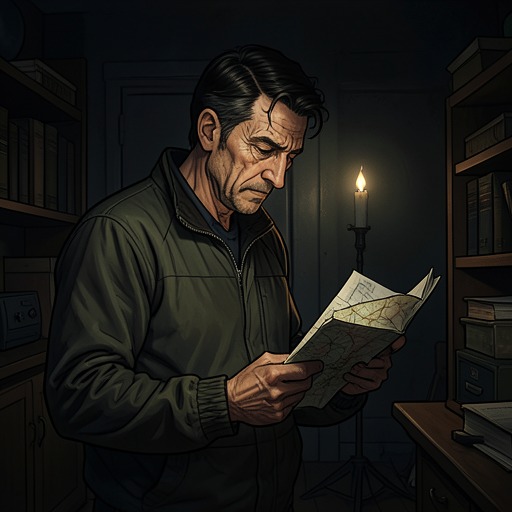
Partway up Mount Obuchi, an outcrop looks over the entire town. It is Asuna’s favorite lookout point, and after school she goes there to listen to Asuna’s Crystal Radio. The view places the town before her, but the height and distance do not by themselves bring her into the company she wants. At the outcrop she can be present above the social world without having to work out how to take part in it.
The narration makes that refuge specific rather than treating it as a general preference for being alone: Asuna longs to spend after-school hours with friends, yet the outcrop is comfortable precisely because she need not concern herself with other people there. Her routine thus holds two truths at once. The overlook answers an immediate need for ease, while the wish that she cannot yet translate into friendship remains unresolved. The contrast becomes a useful measure of the change in her circumstances when the place later leads her toward Shun and, beyond him, to a world outside the town she can see from above.
Shun and the Passage Beyond the Familiar
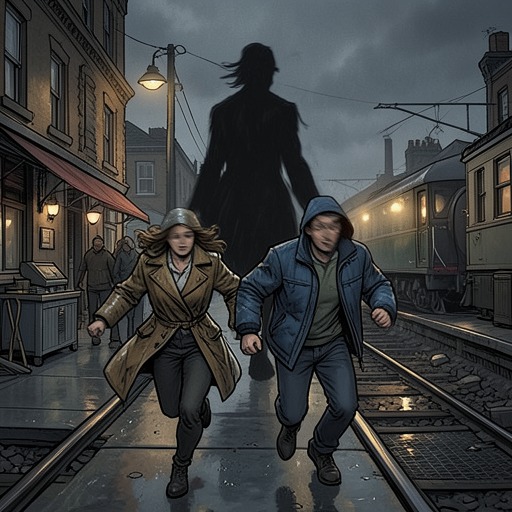
Asuna’s movement toward that wider world begins in danger. After a monster attacks, she next finds herself in a boy’s arms, about ten meters away from the creature’s range. He sets her on her feet, then stands in front of her to shield her. His smile is gentle, and he reassures her that she is all right. The immediate facts of the rescue establish a relationship through action: before Asuna knows what his appearance or presence means, the boy has put himself between her and the threat.
The narrative later identifies the boy as Shun. When Asuna reaches her familiar outcrop, breathless, she finds him there in an unfamiliar leather cloak and unconventional clothes. The recognition joins the extraordinary encounter to the place of her ordinary after-school habit: Shun is not confined to the frightening scene in which he rescued her, but appears again at the lookout where she listens to the radio. The outcrop becomes a threshold between the life Asuna knows and the journey that will take her into Agartha.
That journey opens onto a landscape sharply unlike the enclosed passage through which the travelers have just emerged. A vast grassy plain stretches toward the horizon, with forests and rivers breaking up the expanse beneath a blue sky; the view seems impossible to believe underground. Asuna breathes out her admiration. Her response marks the scale of the discovery without turning it into an explanation: the underground world is not merely a passage or hiding place, but a landscape broad enough to overturn her expectations of what lies below.
Return and the Meaning of the Journey
Later, a question spoken in Shun’s voice asks Asuna why she came to Agartha. The narration emphasizes that she had never truly considered the question before; when she reaches it, she finally realizes something. The scene makes recognition itself the important event, but the answer is not supplied in the available passage. Asuna’s motive should therefore remain open rather than being replaced with a guessed explanation. What the scene establishes is that the journey has brought her to a question about her own purpose that she had previously left unasked.
After returning to the surface, Asuna looks toward Mount Obuchi and remembers that she has not visited her spot in quite a while. She then gasps: up on the outcrop, she thinks she has glimpsed a blue light. The moment does not confirm what the light is. Its force comes from the possibility it raises and from the location where it appears. The mountain lookout that once offered Asuna solitude and a view over town now carries the memory of Shun and the passage into Agartha. Her story closes not with a definite explanation of the light, but with her attention drawn back toward the place where the familiar and the extraordinary first met.